
Drone Thermal Imaging: See Where Roofs and Walls Lose Heat or Hold Water
We fly roofs and exterior walls with a radiometric thermal camera, by day and after dark. Every area that behaves like heat loss or trapped moisture is outlined, located and ranked, so your team knows where to look first instead of guessing from colorful pictures.
Roof surveys from $1,250
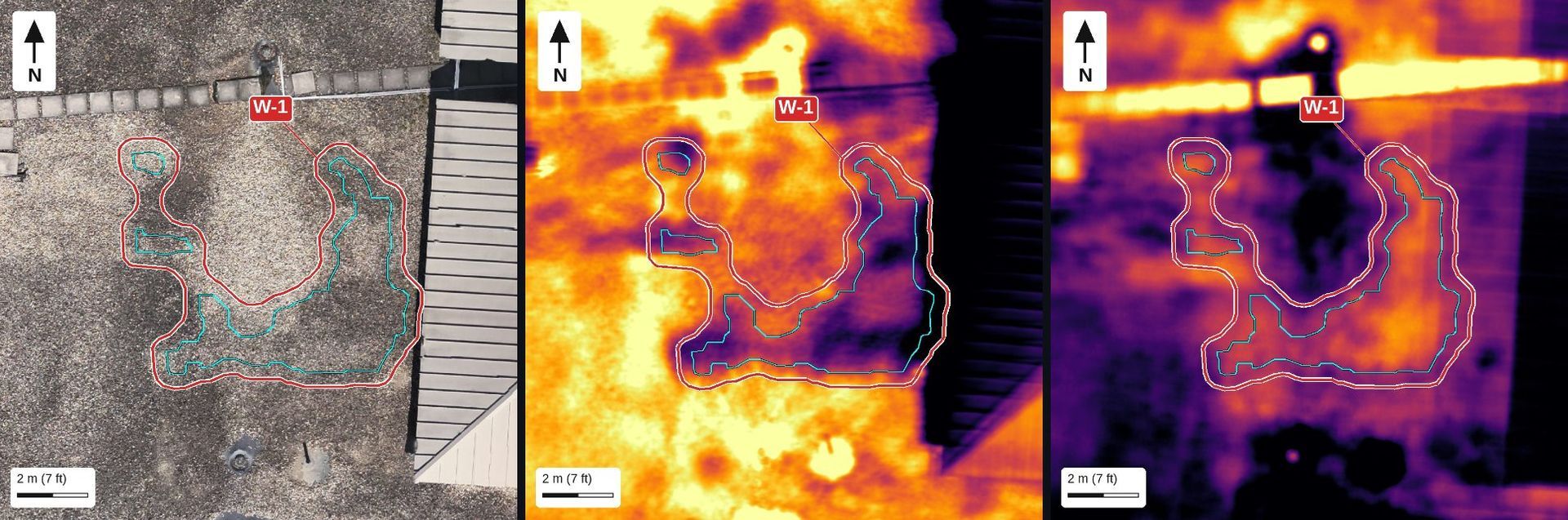
Most building problems are invisible until they're expensive
Missing insulation, air leaks and wet roof layers all look fine from the outside. They show up as higher energy bills, comfort complaints, rot and failed roofs, usually long after the work that caused them is covered up.
A thermal survey from the air shows where to look. You get each suspect area's location and size on a measured map of the building, ranked by how strongly it stands out. That turns "we think there's an issue on the north wall" into a short list your roofer, consultant or engineer can verify and price.
Radiometric, not just colored. Our camera records a temperature in every pixel, and each report logs the weather during the flights. Your consultant can open the original images and check our work.
Built on the standard. Roof moisture work follows ASTM C1153, which pairs infrared with core sampling to confirm what the camera finds.
We say what we can't see. Wind, sun, recent rain and reflective surfaces can hide or fake an anomaly. Every report states the conditions and limits that applied to your building.
Three kinds of aerial thermal survey
Exterior envelope
Walls, parapets, roof edges and window lines, flown after dark in the heating season when warm air escaping from inside shows clearly. We outline areas that behave like missing insulation, thermal bridging or air leakage and mark them on a measured photo of each elevation.
Roof moisture
Day and night flights over low-slope roofs locate insulation that behaves like it's wet, measured in square feet and ranked for core sampling. Our most-requested thermal survey has its own page: roof moisture surveys →
New-roof and closeout baselines
At substantial completion, a day and night flight records the new roof and the outside of the building before the warranty starts. If a leak or dispute comes up later, the owner has a dated thermal record to compare against.
Before and after repairs
Fly before a roof or envelope repair to scope it, then again afterward to confirm the fix worked. Dated records also support insurance claims and disputes.
Today we work from the air only. Interior, electrical and mechanical scans need a handheld camera and further certification, which we're adding. Ask us if you need those and we'll tell you when they're available.
Five steps from question to repair scope
-
Intake
Which buildings, roofs and elevations, and the decision the data has to support: a retrofit design, a repair budget, a warranty file or a capital plan. We confirm airspace, a launch spot and a site contact.
-
Pick the window
Envelope flights need a real indoor-outdoor temperature difference, so they run on cold nights, usually November to March. Roof flights need a sunny, dry day and a clear night. We schedule around the forecast and tell you why.
-
Fly
Day and night flights from saved positions, with a visible-light photo paired to every thermal frame. We log temperature, wind and humidity during each flight.
-
Analysis
Suspect areas are outlined, measured on the map and ranked High, Medium or Low for verification. We screen out reflections, shadows and surface materials before anything goes in the report.
-
Report and review
A branded PDF with each finding, its images and a recommended next step, plus GIS and CAD files. We walk your team through it on a call.
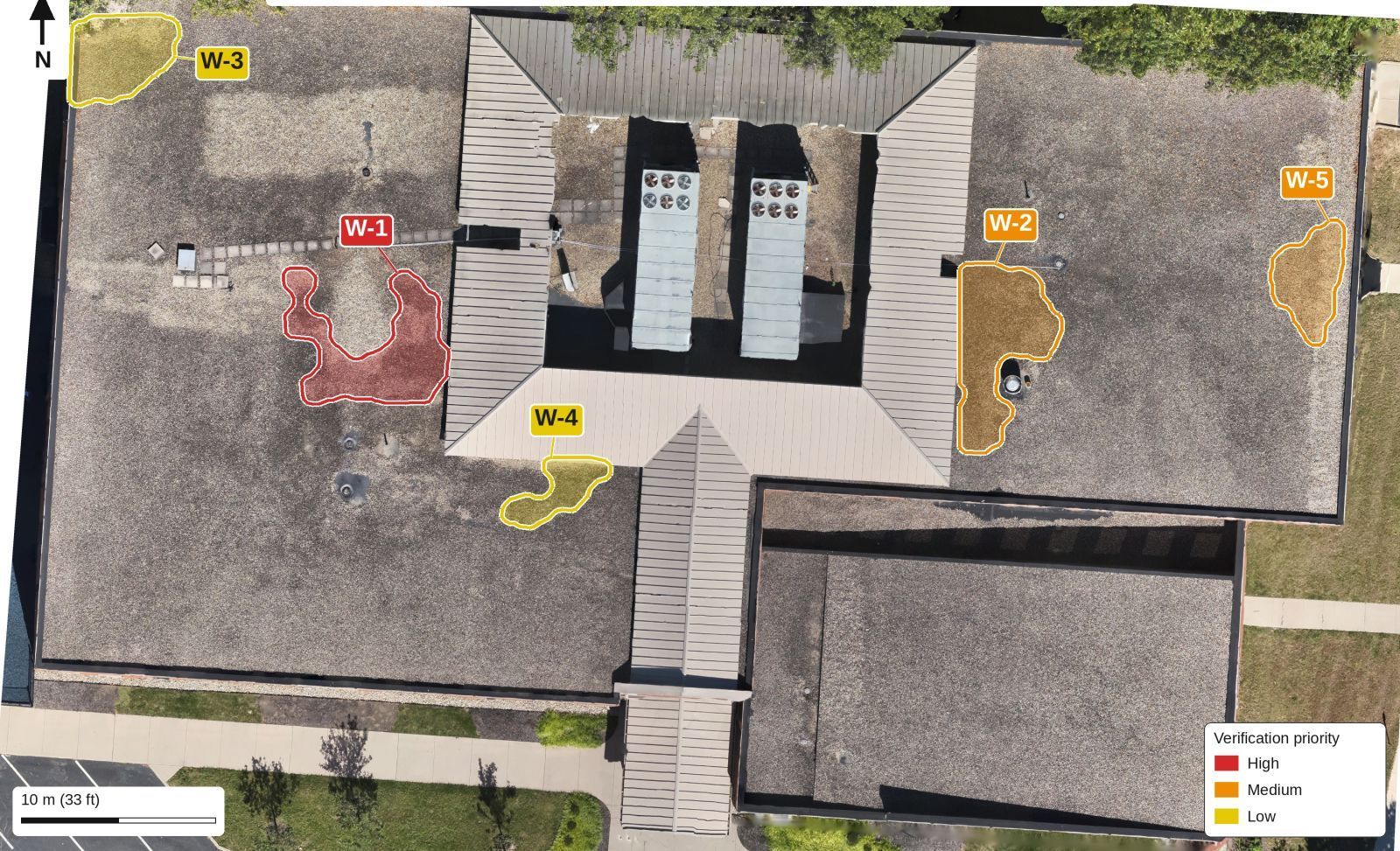
A report your engineer, contractor and owner can all act on
- Findings report (PDF). Each suspect area with its location, size, thermal and visible images, priority and recommended next step.
- Finding map. Every area plotted on a measured aerial or elevation photo, so you see where problems cluster.
- Radiometric originals. R-JPEG files plus annotated JPEGs, for re-analysis by your own consultant.
- GIS and CAD files. Finding outlines as KML, GeoJSON, CSV and DXF; a thermal orthomosaic (GeoTIFF) for roofs.
- Conditions log. Temperature, wind, humidity and recent rain at the time of each flight.
Priced per building
Travel within 50 miles of Columbus is included; beyond that, mileage is billed at the IRS rate. Night flights are included and rush schedules are available. Core sampling, interior testing and repairs are handled by your consultant or contractor.
Roof moisture survey
Existing low-slope roofs, surveyed day and night and ranked for core sampling.
- Day and night thermal flights
- Ranked zones with ft² and GPS
- Thermal orthomosaic
- Report and GIS files
Envelope survey
One building: every exterior elevation and the roof edges, flown on a cold night.
- Night thermal flights of every elevation
- Ranked finding map
- Report with images per finding
- KML, CSV and DXF files
New-roof baseline
A dated record of a new roof and envelope at substantial completion, for the warranty file.
- Day and night flights
- Thermal and visible orthomosaics
- Baseline report
- Re-fly option for warranty claims
Independent data for the people who design, build and maintain buildings
Architects & envelope consultants
Exterior findings before a renovation, adaptive reuse or recover, plotted on a measured photo of each elevation.
Engineers
A ranked list of exterior heat-loss and moisture areas to check, with the original radiometric images for your own analysis.
Contractors
A dated baseline of the new roof and envelope at turnover, and checks of finished roof sections before the next trade covers them.
Owners & facility managers
A short list of where to look first. We don't sell roofing, insulation or repairs, so the findings stay neutral.
Frequently asked
When is the best time to scan?
Envelope flights need at least an 18°F (10°C) difference between inside and outside, so cold nights from late fall to early spring work best in Ohio. Roof surveys need a sunny, dry day followed by a clear night.
Do you need roof or building access?
No. We fly from the ground, usually from a parking lot, and nobody needs to go on the roof or into the building. For envelope flights, we ask that the heating runs normally and doors and windows stay closed.
Can you scan inside, or check electrical panels?
Not yet. Today we work from the air only. Interior, electrical and mechanical thermography need a handheld camera and further certification, which we're adding.
Does a thermal image prove there's a problem?
No. It shows areas that behave like a problem. Wet insulation is confirmed with cores, and air leaks with on-site testing by your consultant. Our report ranks findings so verification is quick and inexpensive.
How is this different from a roof moisture survey?
A roof moisture survey is one specific thermal method for low-slope roofs, with its own page and pricing. This page covers exterior walls, new-roof baselines and before-and-after checks. Many buildings get both from one visit.
Are you a licensed engineer?
No. We're FAA Part 107 pilots and a Level 1 sUAS thermographer: we capture radiometric images and locate and rank areas that need a closer look. Our findings support, but don't replace, your engineer, roofing consultant or envelope specialist.
How fast do we get results?
Typically 5–10 business days after the last flight. Rush schedules are available.
Often booked together
Roof Moisture Survey →
Day and night infrared on low-slope roofs.
Drone Mapping & 3D →
A measured aerial to plot findings on.
Aerial Photography →
Progress and condition records.
Aerial Intelligence →
Roof, pavement and façade scoring for property portfolios.
Find the problem before you pay to fix the wrong one.
Tell us the building, what's prompting the question and when you need an answer. We'll check whether the season and the building suit an aerial survey, then send a fixed quote and a flight window within one business day.