
L1 Thermographer
Infrared Roof Moisture Survey · Low-slope roofs
Find the wet insulation before it turns into a full replacement
We fly your roof twice — once in afternoon sun, once after dark — with radiometric thermal cameras, then map every area that behaves like trapped moisture. You get a ranked, measured map of where to cut cores, not a folder of colorful pictures.
Starting at $1,750 per building
FAA PART 107 LEVEL 1 SUAS THERMOGRAPHER MBE · EDGE CERTIFIED OSHA 10
2 flights
Day + night, same roof, same grid
°F per pixel
Radiometric temperatures, not just color
ft² + GPS
Every suspect area measured and located
5–10 days
Typical turnaround after the night flight
WHY IT MATTERS
Most roofs don't need replacing. They need the wet parts found.
Water that gets past a membrane soaks into the insulation below and stays there, often without a single ceiling stain. Wet insulation loses its R-value, rots decking and fasteners, and quietly spreads. Without a map, owners are left choosing between patching blind and paying for a full tear-off.
A moisture map changes that decision. If wet areas are a small fraction of the field, the usual path is targeted removal and replacement plus repair of the source. If they're widespread, you have documented evidence for a capital request or a warranty claim.
Code matters here. The International Building Code (§1512) doesn't allow a new roof to be laid over an existing roof with water-soaked insulation. Knowing where — and how much — is wet decides whether a recover is even an option.
Built on the standard. Our method follows ASTM C1153, the standard practice for locating wet insulation in roofing systems with infrared imaging, including verification of suspect areas by core sampling.
We say what we can't see. Shadows, reflective surfaces, ponded water and recent rain can mimic or mask moisture. Every report states the limits that applied to your roof.
HOW IT WORKS
Six steps from roof to repair plan
01
Intake
Roof plans, age, system type and known leaks. We confirm access, airspace and the right weather window.
02
Day flight
High-resolution visible imagery and a sun-loaded thermal pass, stitched into a measured orthomosaic of the whole roof.
03
Night flight
After a clear, dry day the roof gives back its heat. Wet insulation holds it longer and shows up warm — this is the primary detection pass.
04
Analysis
Day and night temperatures are registered to the same grid. Areas that reverse between day and night are traced, measured and ranked.
05
Report
A branded PDF with a zone map, per-zone temperatures and imagery, plain-language interpretation and a recommended next step for each zone.
06
Verification
Zones are verified by moisture meter and core cuts — by your roofer or consultant, or by our partners — before any money is spent on repairs.
WHAT YOU GET
A report your roofer, engineer and board can all act on
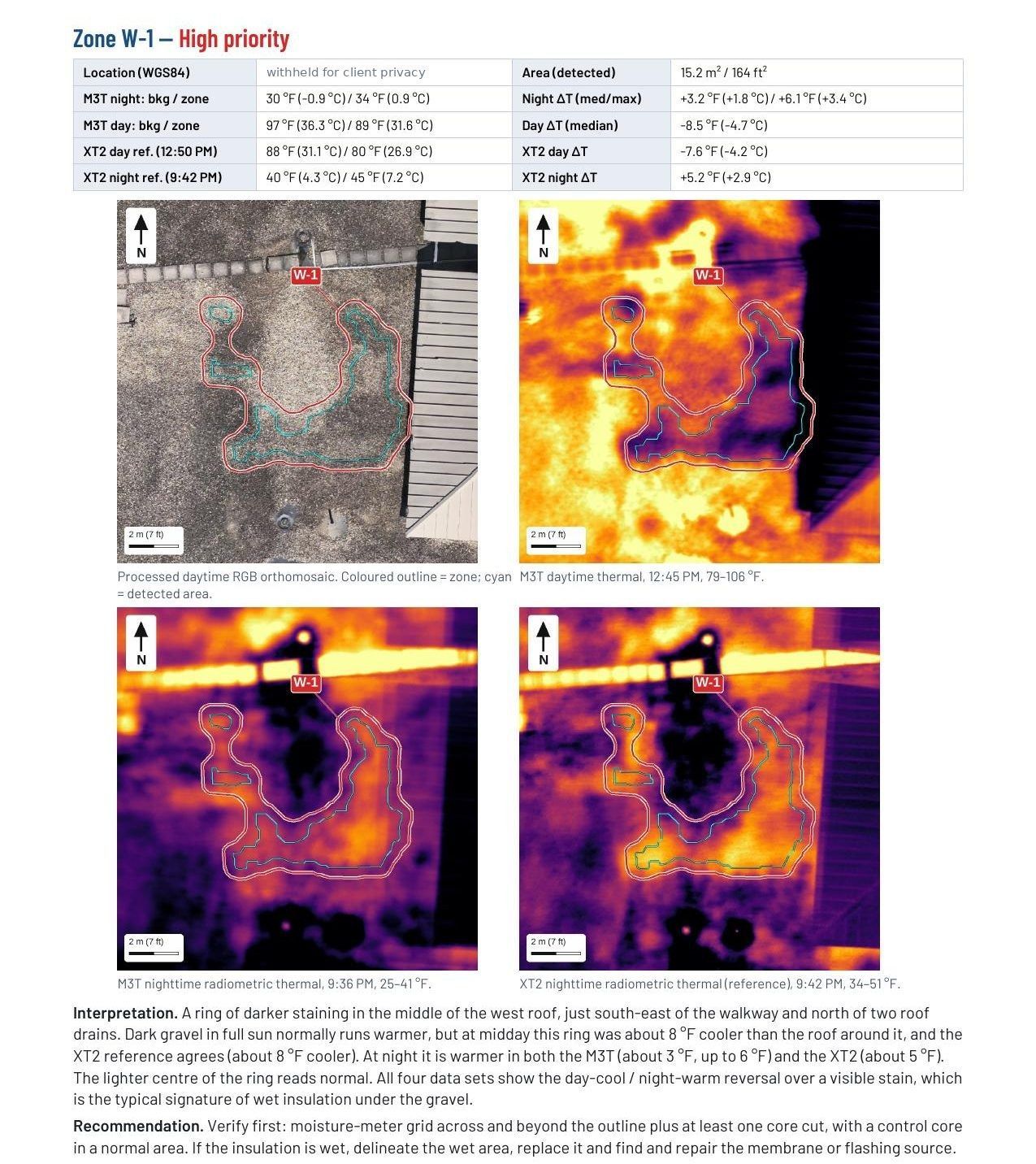
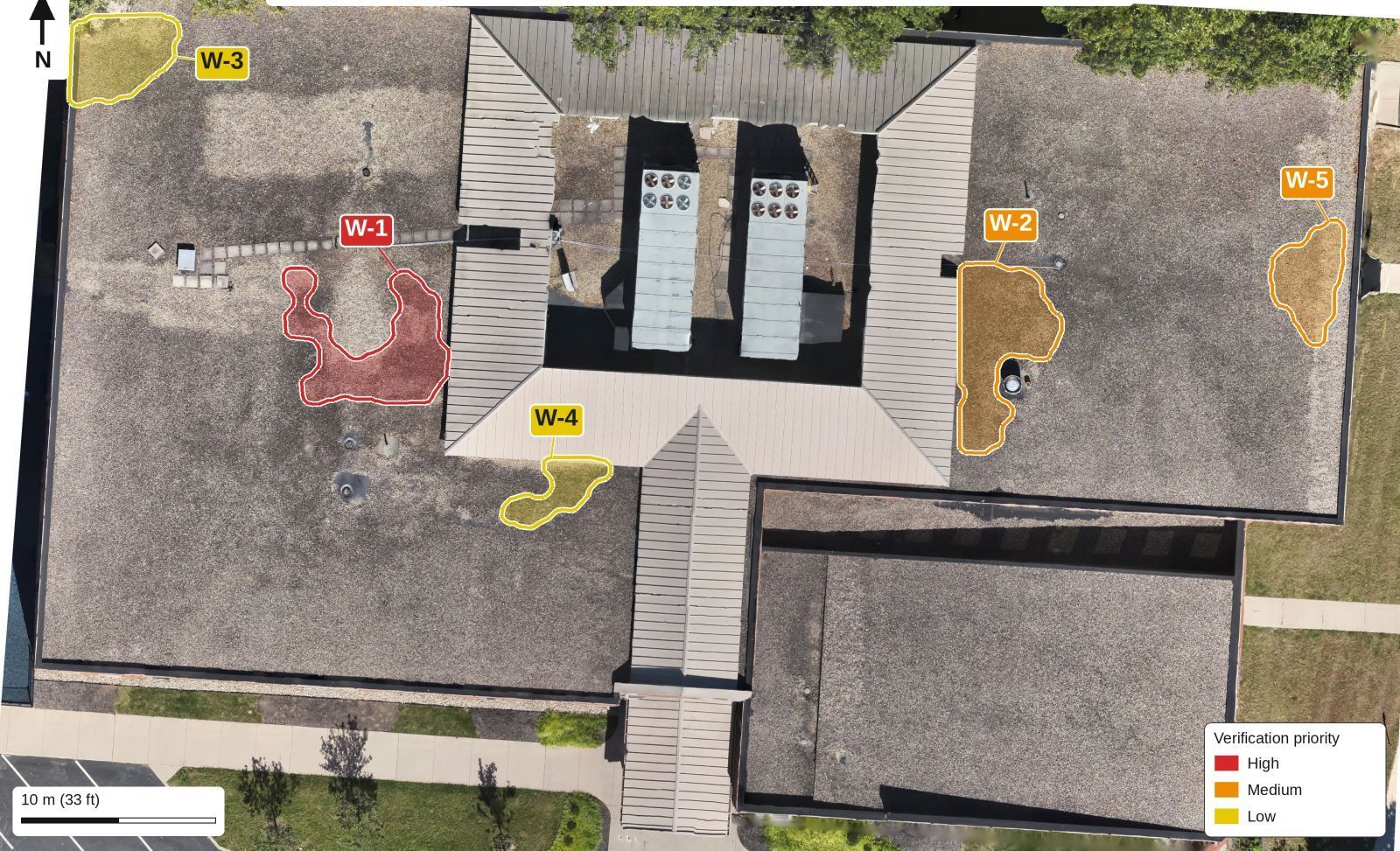
- Zone map — every suspect area outlined on a measured aerial of your roof, ranked High / Medium / Low verification priority.
- Zone pages — area in ft², GPS location, day and night temperatures in °F (°C), side-by-side imagery and a recommendation.
- Full-roof orthomosaics — visible, day thermal and night thermal, as GeoTIFFs.
- GIS & CAD files — zone outlines as KML, GeoJSON and CSV for Google Earth, GIS or your drawing set.
- Annotated images — the original drone frames for each zone, labeled.
- Other findings — ponding, drainage, open seams and equipment issues we see along the way.
PRICING
Per building, priced by roof area
Minimums cover roofs up to roughly 25,000–35,000 ft². Larger roofs are quoted per square foot. Core sampling, travel beyond 50 miles and add-ons are quoted separately.
Screening
Starting at $1,750
A fast first look — portfolio triage, pre-purchase, or "is there a problem here?"
- Night thermal flight
- Visible orthomosaic
- Zone map with suspect areas
- Short summary report
MOST CHOSEN
Standard Survey
Starting at $2,500
The full day + night survey for repair planning, bid documents and warranty reviews.
- Day and night thermal flights
- Ranked zones with ft², GPS and temperatures
- Full branded report with zone pages
- GeoTIFF, KML, GeoJSON and CSV files
Decision Package
Starting at $3,500
For owners deciding between repair, recover and replacement — schools, municipalities, capital planning.
- Everything in Standard
- Core-cut plan and verification coordination
- Section-by-section condition summary
- Repair / recover / replace action plan
Multi-building
Volume pricing from 10% off
Annual programs
Recurring surveys for portfolios
Re-survey after repair
Confirm the fix worked
Results presentation
For boards and committees
WHO IT'S FOR
Independent data for the people who pay for roofs
Schools & districts
Prioritize capital dollars across buildings and back up bond or levy requests with measured evidence.
Municipalities
Documented, repeatable condition data for public buildings and procurement files.
Engineers & consultants
Georeferenced thermal data and zone files that drop straight into your assessment and specs.
Owners & property managers
Know what you have before a roofer quotes it. We don’t sell roofing, so the map stays neutral.
FROM THE FIELD
A 53,000 ft² high school that didn’t need a new roof
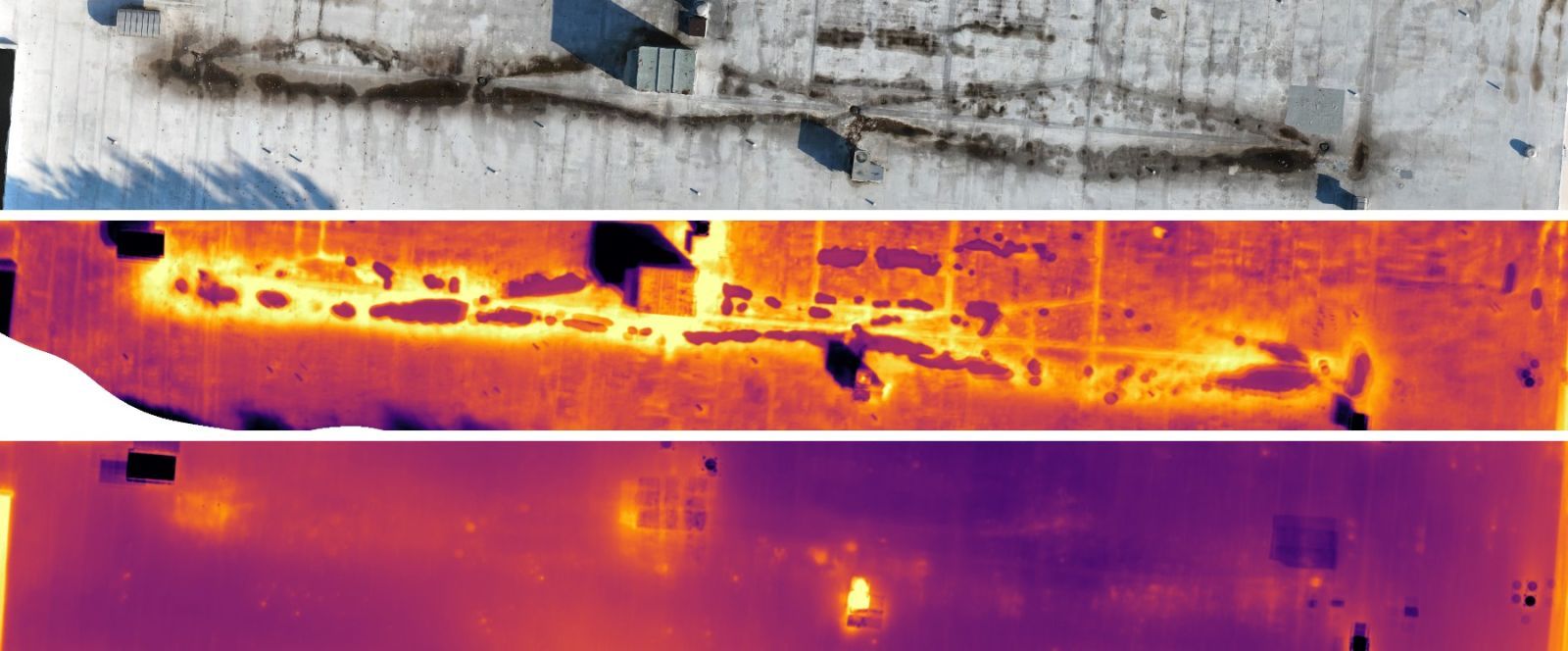
A central Ohio district wanted to know how much of its low-slope roof was holding water before planning work. The survey found far less than feared.
- Roof
- ~53,000 ft² low-slope, multiple sections
- High priority
- One area, about 101 ft²
- Drainage
- 260 ft ponding line holding water 3 days after rain
- Suspect wet
- Under 1% of the roof
- Recommendation
- Verify one zone, fix drainage, repair locally — no tear-off indicated
QUESTIONS
Frequently asked
What roofs does this work on?
Low-slope commercial roofs with insulation above the deck: built-up and gravel (BUR), modified bitumen, and single-ply (TPO, EPDM, PVC). Highly reflective or ballasted surfaces have limits we’ll discuss up front. Steep-slope shingle roofs are a poor fit for this method.
Why fly at night?
During the day the sun heats everything and can hide wet spots. After sunset, dry insulation cools quickly while wet insulation holds heat and stays warm. Comparing day and night lets us separate real moisture from shadows, stains and surface materials.
What weather do you need?
A clear, sunny day with a dry roof surface, light wind, and no rain in the preceding day or so. We watch the forecast and schedule the flights for the right window — that’s the main reason we ask for some flexibility on dates.
Does a thermal survey prove the insulation is wet?
No — and anyone who says otherwise is overselling. Infrared finds areas that behave like moisture. Core cuts and moisture meters confirm it. Our report ranks the zones so verification is fast and cheap.
Do we need to be on site or shut anything down?
No. We fly from the ground, usually from a parking lot, with no roof access needed. We coordinate with your facilities team and handle any airspace authorizations.
Will you tell us to replace the roof?
We don’t sell or install roofing. The report gives a recommended next step for each zone and leaves repair, recover or replace decisions to you and your roofing professional or engineer — with the data to make them.
How fast do we get results?
Describe the item or answer the question so that site visitors who are interested get more information. You can emphasize this text with bullets, italics or bold, and add links.